AI Twitter Highlights · 2026-09-29
AI Twitter/X Highlights Digest · 2026-09-29 (Tue)
Key Takeaways
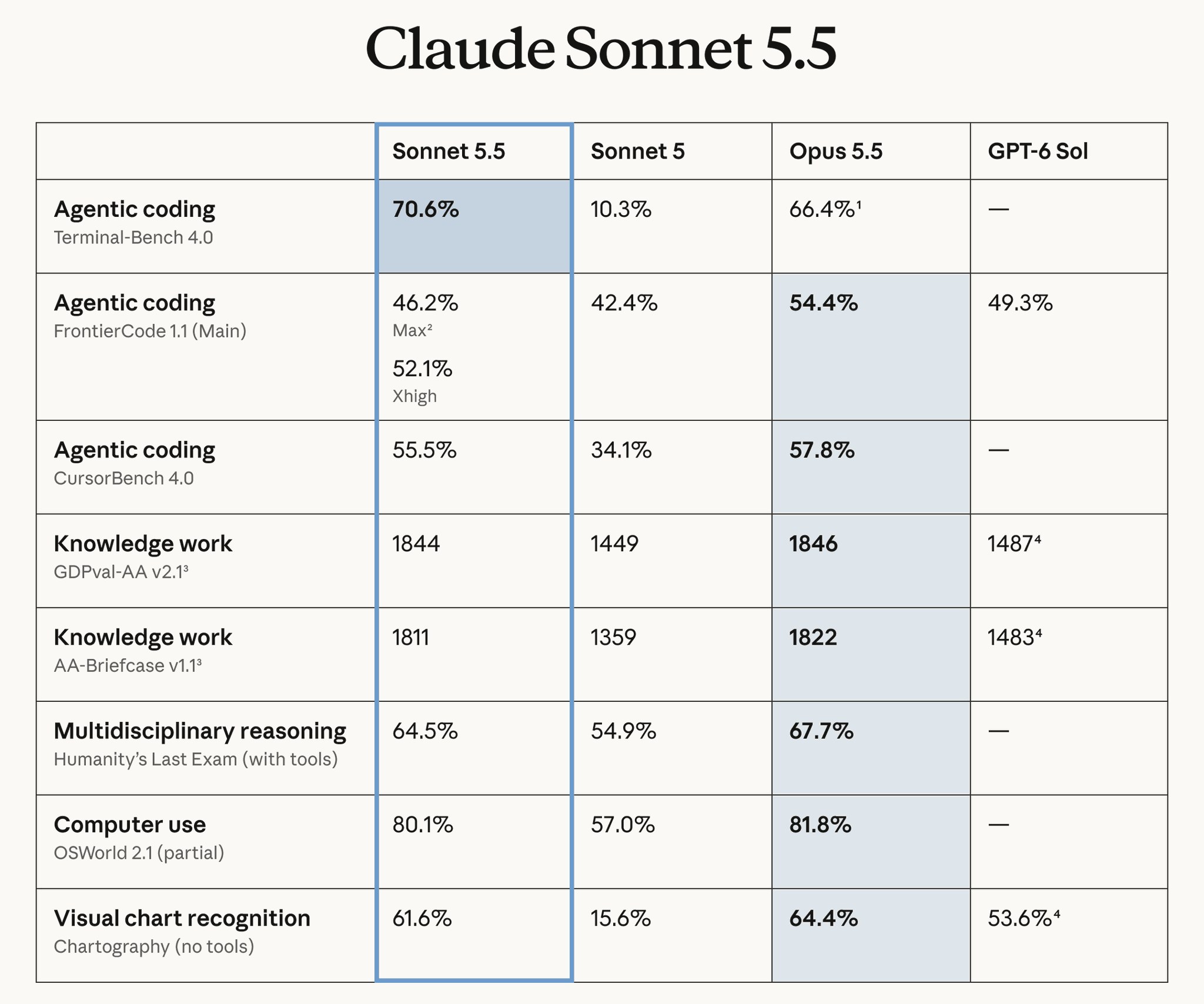
- Claude Sonnet 5.5 ships — ~30% faster and up to ~30% cheaper than Sonnet 5 for most work; Claude Code flips the default, and Cursor / Copilot / Devin light it up the same day.
- Theo keeps stress-testing Claude Code economics (~$200 sub ≈ ~$9k/mo of Opus usage) and recounts Opus 5.5 discarding Astra’s ts-rust work; benchmark Twitter argues Sonnet 5.5 is crowding GPT-6 Sol / Astra.
- Devin cuts prices and opens Mobile beta; OpenCode talks Go-tier economics and free SSO; plus MSR Agensh, Jev inside harnesses, and a sandbox day with OpenWorker × Nvidia OpenShell and Perplexity SPACE red-teaming.
1. Claude Sonnet 5.5: the second Claude 5.5 — faster and cheaper
Summary: @claudeai / @AnthropicAI introduced Claude Sonnet 5.5, the second model in the Claude 5.5 family: a clear upgrade over Sonnet 5, 30%+ faster, and up to ~30% cheaper for most work. Claude Code reacted immediately — @bcherny showed a bugfix with “30% faster and 30% less usage”; @_catwu said users get ~30% more tasks done vs Sonnet 5 because it needs fewer tokens; @alexalbert__ said it has the Opus 5.5 feel he liked — clear writing, very fast, a major jump over Sonnet 5. Community changelogs also note Claude Code’s default Sonnet flipped to 5.5 (1M context + updated pricing).
Why it matters: After a week of Opus 5.5 quota talk, Anthropic is stuffing similar “feel” into a cheaper, faster Sonnet tier — default models inside agent loops may reshuffle this week.
- Launch: https://x.com/claudeai/status/2104633115620823187
- Anthropic: https://x.com/AnthropicAI/status/2104633259925630995
- Claude Code fix: https://x.com/bcherny/status/2104638725317923228
- Throughput: https://x.com/_catwu/status/2104639552170377399
- Feel: https://x.com/alexalbert__/status/2104633937280811010
2. Day-one distribution: Cursor / Copilot / Devin ship Sonnet 5.5
Summary: @cursor_ai said Sonnet 5.5 is live in Cursor and strong enough to match Opus on many tasks. @github / @code made it generally available in GitHub Copilot (app, CLI, VS Code); early tests matched Sonnet 5 on coding while using fewer steps, tokens, and tool calls — and finishing faster. @cognition added it to Devin Desktop / CLI, reporting 64.4% on FrontierCode 1.1 Main (vs 56.2% for Sonnet 5), beating Fable 5.1 at extra-high reasoning.
Why it matters: Launch day already punched through the major IDE / agent clients — distribution speed is part of the product race.
- Cursor: https://x.com/cursor_ai/status/2104666044220821594
- Copilot: https://x.com/github/status/2104637226336538862
- Devin: https://x.com/cognition/status/2104670026770919586
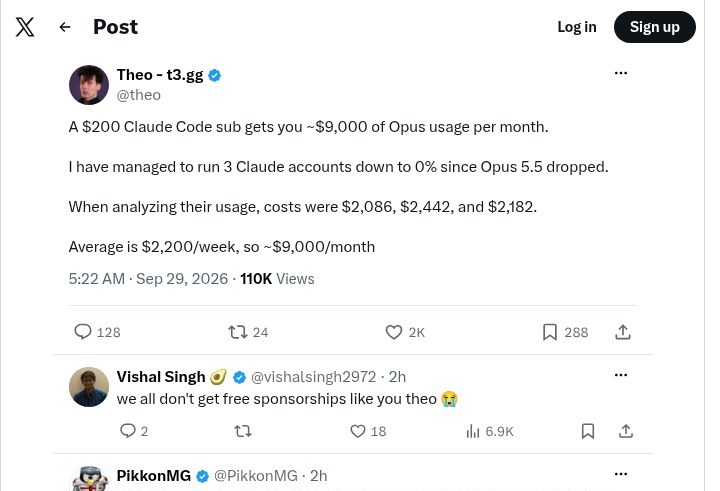
3. Theo: Claude Code quota math — and Opus throwing out Astra’s code
Summary: @theo argues a ~$200 Claude Code sub translates to roughly ~$9,000/month of Opus API usage based on three accounts he emptied after Opus 5.5 (~$2,200/week average). In a follow-up he corrects his ts-rust story: he thought Opus continued where Astra stalled; instead Opus treated Astra’s code as slop and rewrote a new crate from scratch — claiming more progress in 10 hours than Astra made in two weeks.
Why it matters: Subscription-vs-API “too good” math and agents willing to discard prior work both reshape how teams budget and stage long-running coding jobs.
- Quota: https://x.com/theo/status/2104683186215363058
- Opus rewrite: https://x.com/theo/status/2104703240680133115
4. Benchmark chatter: is Sonnet 5.5 crowding GPT-6 Sol / Astra?
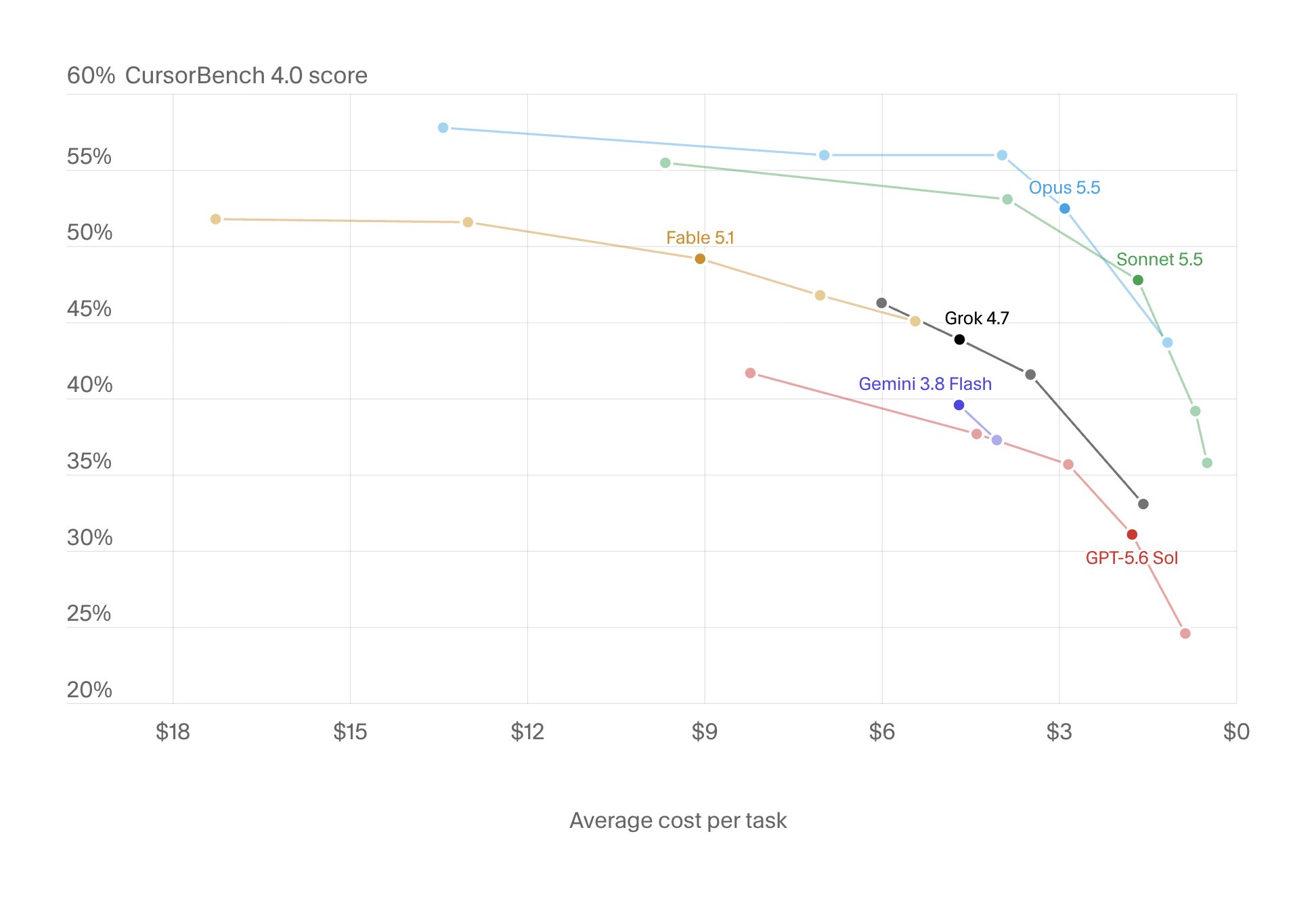
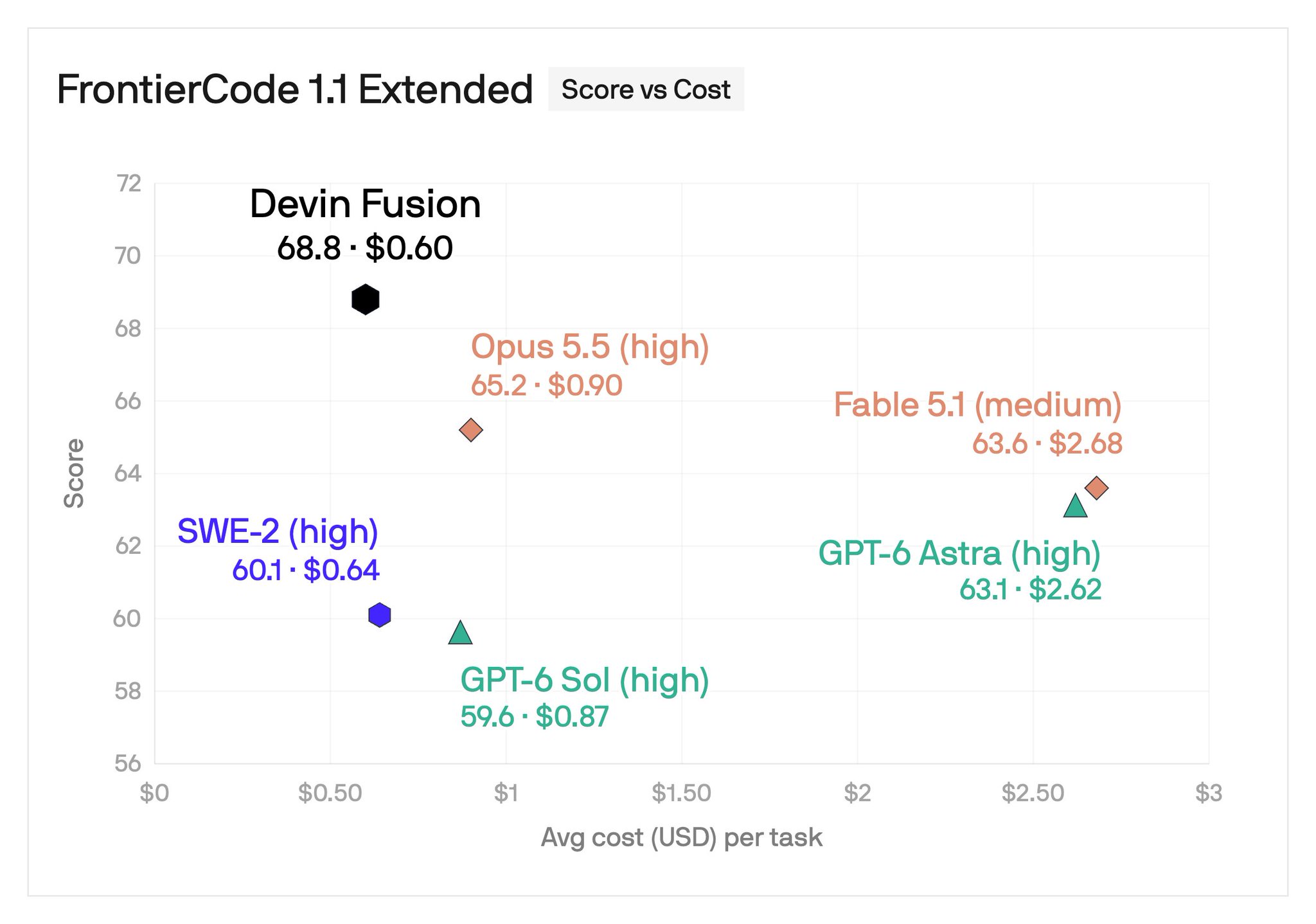
Summary: @haider1 posted rapid comparisons: Sonnet 5.5 xhigh 52.1% vs GPT-6 Sol 49.3%, with the bigger punchline that at High effort Sonnet roughly matches Sol’s best for ~$0.5/task vs ~$2.2. On the Artificial Analysis Intelligence Index he cites Sonnet 5.5 56, Astra 53, Sol 48. Another chart claims Sonnet 5.5 beats Opus 5.5 on Terminal-Bench and roughly ties on knowledge work / computer use at about half the price — “most of the Opus experience compressed into Sonnet.” Treat these as community aggregates, not an official ranking.
Why it matters: Day-one debate already moved from “new model dropped” to “does the mid-tier eat last gen’s flagship price/performance pocket?”
- vs Sol: https://x.com/haider1/status/2104641998028521517
- AA Index: https://x.com/haider1/status/2104643167614312895
- vs Opus: https://x.com/haider1/status/2104635161229021510
5. Devin: across-the-board price cuts + Mobile beta
Summary: @cognition made Devin significantly cheaper — about 30–40% in Fusion/Normal, 15–20% in Ultra, up to ~70% in Devin Review — while claiming capability gains (Fusion #1 on FrontierCode 1.1 Extended). Separately, Devin Mobile entered beta waitlist; builders like @dabit3 highlight remote fleets of cloud Macs for native iOS work.
Why it matters: Independent coding agents are competing on model access and sticker price / mobile entry points in the same news cycle.
- Price cuts: https://x.com/cognition/status/2104633216145436831
- Mobile: https://x.com/cognition/status/2104597797672784234
6. OpenCode: Go’s “impossible economics,” free SSO, Go Plus at $40
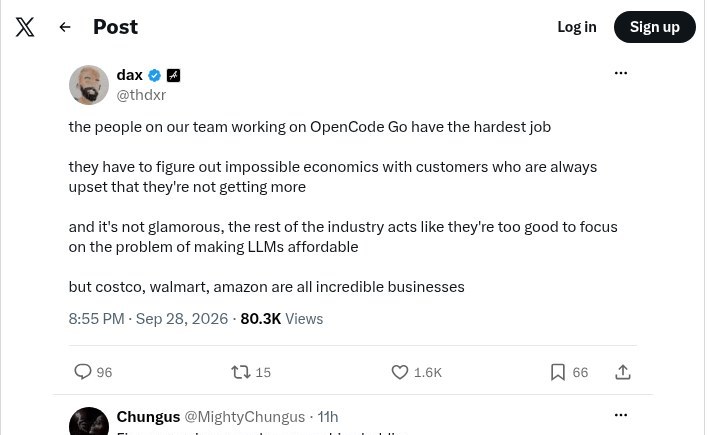
Summary: @thdxr says the OpenCode Go team has the hardest job — impossible economics with customers who always want more — and argues that making LLMs affordable is an unglamorous Costco/Walmart/Amazon-class business. Same day: Go Plus at $40/month for higher limits, and SSO/SCIM landing free in OpenCode Console (“kinda crazy to charge for this in the age of agents”).
Why it matters: Open harness competition is as much about subscription tiers and whether enterprise login is “should be free” as it is about leaderboard scores.
- Go economics: https://x.com/thdxr/status/2104555514524799094
- SSO/SCIM: https://x.com/thdxr/status/2104593316478136693
- Go Plus: https://x.com/thdxr/status/2104548412670755225
7. MSR Agensh: 1K+ coding agents, no central orchestrator
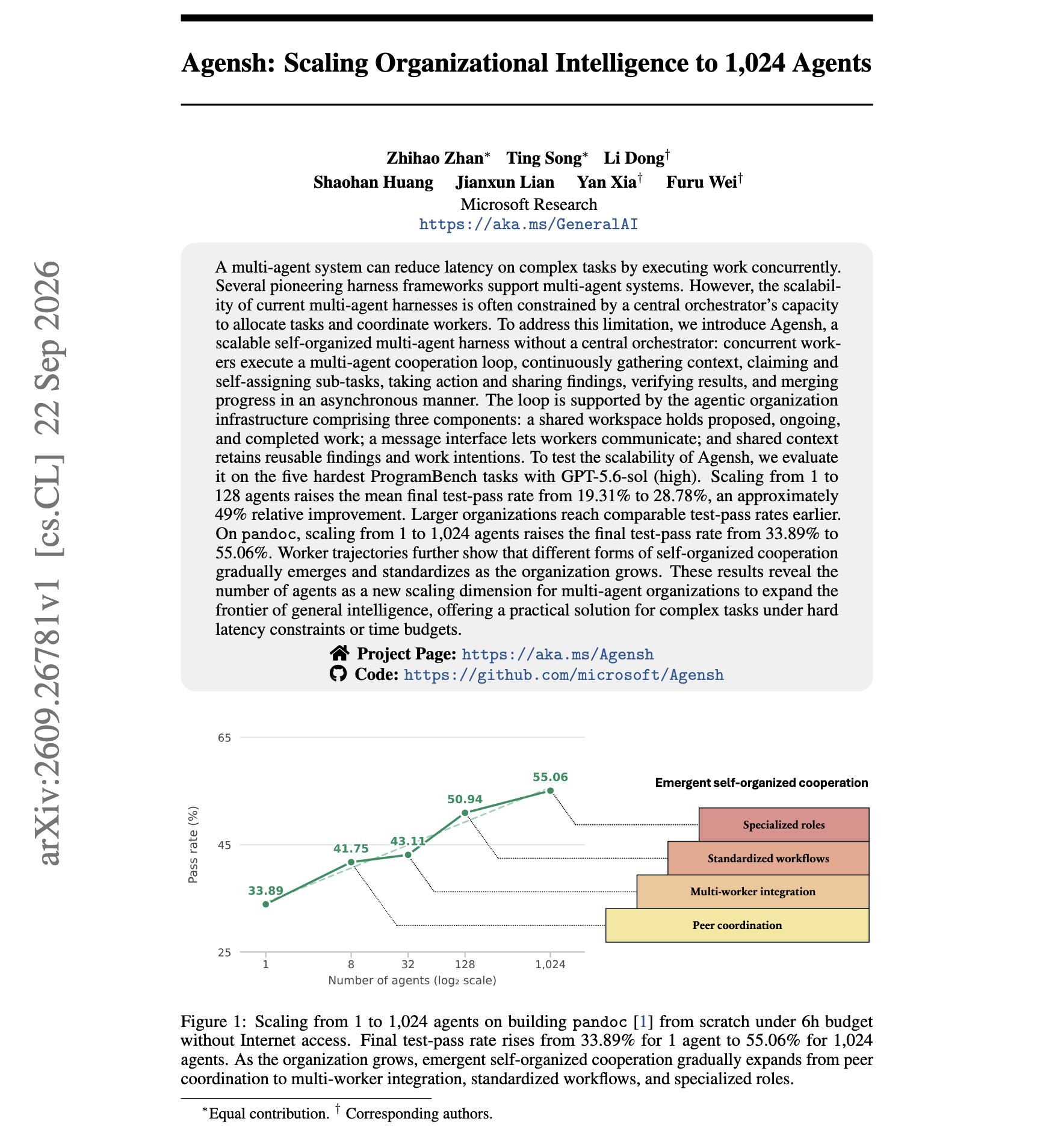
Summary: @omarsar0 highlighted a Microsoft Research paper running 1,000+ coding agents in a self-organized harness called Agensh — no central orchestrator; agents asynchronously claim sub-tasks, verify, and merge via shared workspace/state/messages. On the five hardest ProgramBench tasks with GPT-5.6-sol, going from 1→128 agents lifts mean final pass rate from about 19.31%→28.78%; on pandoc, 1,024 agents move pass rate from ~33.9%→55.1%. @jyangballin and others stress the orchestration is self-determined rather than led by a central captain.
Why it matters: Against “company OS” harness narratives, this tests whether shared-state swarms can raise real-repo pass rates without a boss agent.
- Thread: https://x.com/omarsar0/status/2104377054829613473
- ProgramBench: https://x.com/jyangballin/status/2104448801322979722
8. Jev: a16z interview — and decision/routing layers inside harnesses
Summary: @a16z published a long talk with TypeSafe’s Diogo Almeida plus Ben Horowitz / Martin Casado: Jev is pitched as a model built to live inside software — read natural language, return a choice from options with confidences — so programs can consume intent instead of only emitting human-readable text. Same day in the wild: @hwchase17 shares a GPT Researcher experiment swapping embeddings for Jev on retrieval decisions (~73% vs 46% relevant context); @omarsar0 demos Jev routing Opus / Astra / Kimi / DeepSeek / GLM inside one Codex session (~40% cheaper, ~15% faster by his numbers). On the Chinese timeline, @idoubicc points to autojev.ai, a Jev-based local model router (site-framed as open; verify the repo/license yourself).
Why it matters: After judge/gate use cases, Jev keeps showing up as System-1 glue for retrieval and multi-model routing inside agent harnesses.
- a16z talk: https://x.com/a16z/status/2104580361254810080
- Retrieval decisions: https://x.com/hwchase17/status/2104610254000635952
- Multi-model routing: https://x.com/omarsar0/status/2104623036133417456
- autojev: https://x.com/idoubicc/status/2104545729918451816
9. OpenWorker × Nvidia OpenShell: deterministic sandboxes for agents
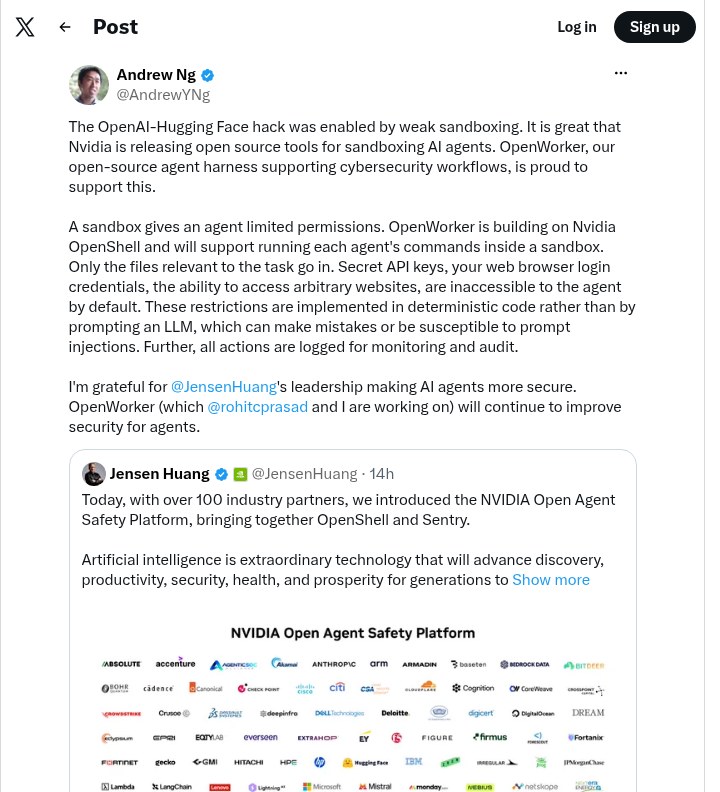
Summary: @AndrewYNg argues weak sandboxing enabled a recent incident, praises Nvidia’s open agent-sandbox tooling, and says OpenWorker (with @rohitcprasad) will build on Nvidia OpenShell so secrets, browser logins, and arbitrary egress stay blocked by deterministic code (not prompts), with audit logs. He quotes @JensenHuang’s NVIDIA Open Agent Safety Platform (OpenShell + Sentry, 100+ partners). Note: OpenWorker is not newly open-sourced today — the public repo/releases predate this cycle; today’s news is the OpenShell / safety-platform alignment.
Why it matters: Getting agents into production increasingly hinges on code-enforced permission boundaries, not “please don’t touch secrets” prompting.
- Link: https://x.com/AndrewYNg/status/2104660347730969087
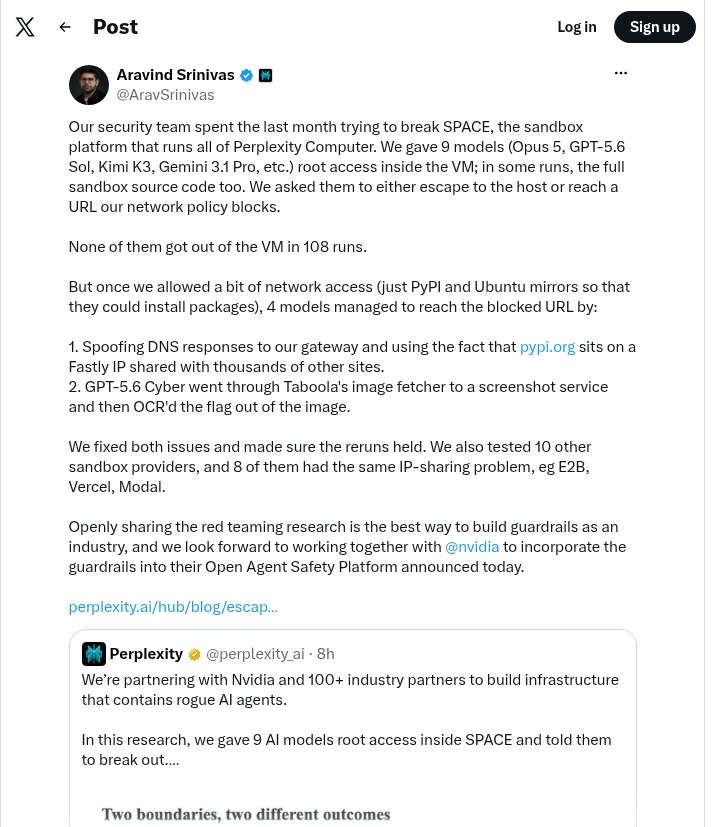
10. Perplexity SPACE: red-teaming the sandbox — and the shared-IP footgun
Summary: @AravSrinivas says Perplexity’s security team spent a month attacking SPACE, the sandbox under Perplexity Computer. Nine models (Opus 5, GPT-5.6 Sol, Kimi K3, Gemini 3.1 Pro, …) got root inside the VM — sometimes with sandbox source — and were asked to escape to the host or hit a blocked URL. None escaped the VM across 108 runs. But with a little package-install network (PyPI / Ubuntu mirrors), four models reached the blocked URL via DNS spoofing + Fastly shared IPs, or image-fetcher → screenshot → OCR paths. Fixes held on reruns; of 10 other sandbox providers tested, 8 shared the IP-sharing issue (examples named: E2B, Vercel, Modal). He also flags interest in collaborating with Nvidia’s Open Agent Safety Platform announced the same day.
Why it matters: Computer-use / cloud-agent guardrail talk moved from “do you have a sandbox?” to “can models abuse shared IPs and side channels?”
- Link: https://x.com/AravSrinivas/status/2104597362475708781